
Ultra-High Performance Concrete (UHPC) has established a new benchmark for strength, durability and structural efficiency in construction.
However, conventional UHPC can involve challenges related to material cost, manufacturing complexity, curing requirements, material availability and production control.
ceEntek developed CNFC™ technology to address these limitations.
CNFC™ (Carbon Nano Fiber Concrete) is ceEntek’s proprietary Carbon-NanoFiber Ultra-High Performance Concrete. It integrates engineered carbon nanofibers into the UHPC system and is designed to improve the efficiency, durability and performance of the cementitious matrix.
CNF does not replace UHPC and should not be understood as a separate class of concrete.
UHPC is the construction material. CNF is ceEntek’s proprietary technology for advancing that material.
This technology contributes to ceEntek’s UHPC 2.0™ platform, which combines CNF with other proprietary material and process technologies to create a more practical, efficient and scalable UHPC system.
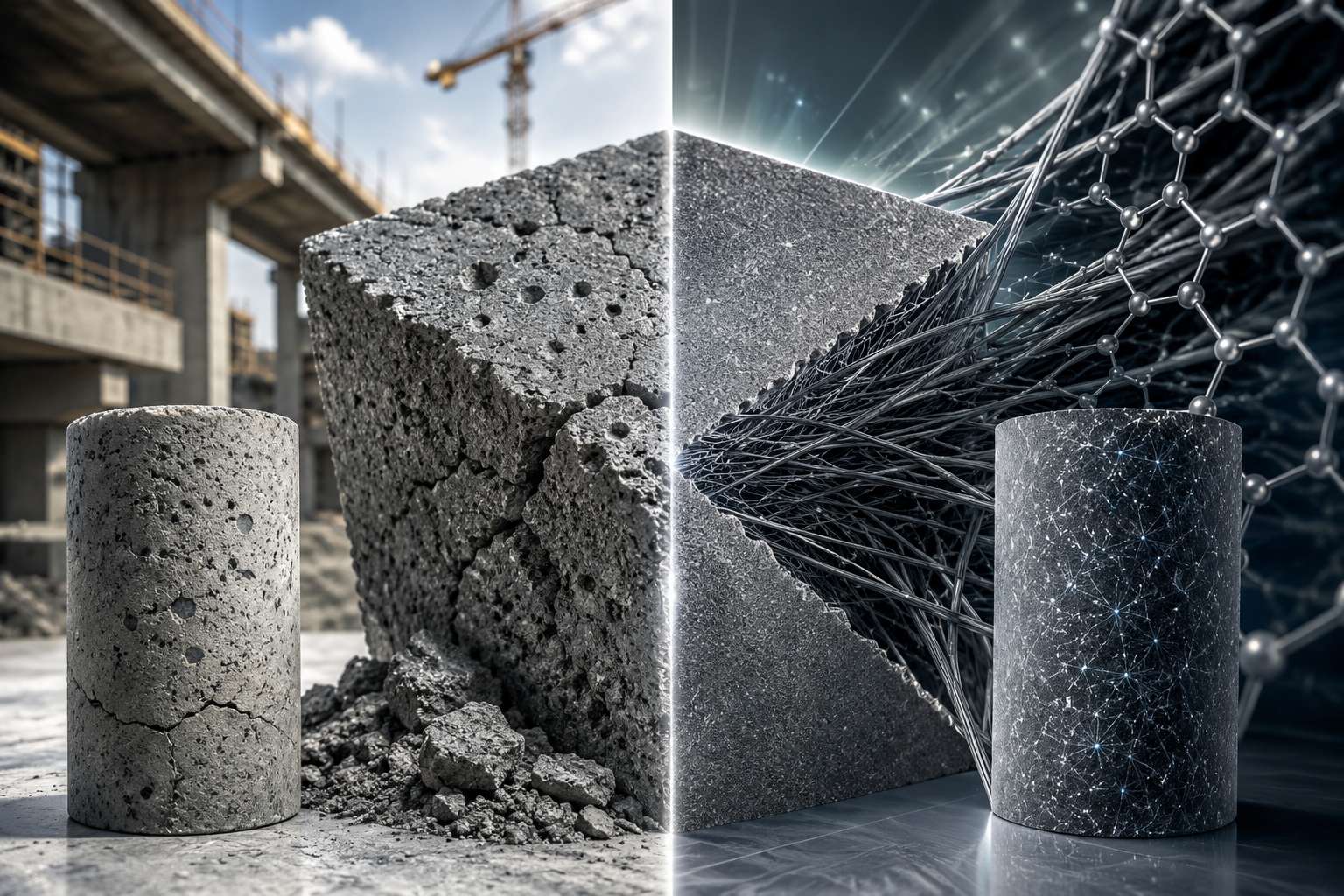
Carbon Nano Fiber Concrete (CNFC) is an advanced cementitious material that incorporates carbon nanofibers into an Ultra-High Performance Concrete (UHPC) matrix. By reinforcing the cement matrix at the nanoscale, CNFC improves resistance to crack initiation and propagation while enhancing overall mechanical performance and durability.
Unlike conventional concrete, which depends largely on steel reinforcement to resist tensile forces, CNFC strengthens the concrete itself at the microscopic level. This additional level of reinforcement complements traditional steel fibers used in UHPC and contributes to a denser, more resilient material.
The result is a concrete specifically engineered for demanding applications where long service life, structural reliability, and minimal maintenance are critical.
UHPC already provides exceptional compressive strength, extremely low permeability, and outstanding durability. CNFC builds upon these characteristics by introducing carbon nanofibers throughout the cement matrix.
Potential advantages include:
Rather than replacing UHPC, Carbon Nano Fiber Concrete represents the next evolution of high-performance concrete by improving material performance at the nanoscale.
Concrete deterioration almost always begins at the microscopic level.
Small cracks develop naturally as concrete cures and ages. Over time, these cracks allow water, chlorides, sulphates, and other aggressive substances to penetrate the structure, eventually causing reinforcement corrosion and structural degradation.
Carbon nanofibers help bridge these microscopic defects before they develop into larger cracks, resulting in a denser and more durable cement matrix.
By improving the internal structure of the concrete itself, CNFC enhances durability long before visible cracking occurs.
The global construction industry is rapidly shifting toward off-site manufacturing, prefabrication, and volumetric modular construction to improve productivity, reduce project schedules, and address skilled labour shortages.
This trend creates new performance requirements for construction materials.
Modules must be transported over long distances, lifted multiple times by cranes, and assembled with tight dimensional tolerances—all while maintaining structural integrity and an attractive finished appearance.
Carbon Nano Fiber Concrete is particularly well suited for these challenges.
Its combination of high strength, enhanced crack resistance, and long-term durability enables manufacturers to produce thinner, lighter, and more robust precast elements without compromising performance.
Potential modular applications include:
For manufacturers, CNFC offers the potential to reduce component weight while maintaining exceptional structural performance. For developers, this can translate into faster installation, lower maintenance requirements, and longer-lasting buildings.
As governments increasingly encourage industrialised construction methods, CNFC has the potential to become a key enabling material for the next generation of modular buildings.
Carbon Nano Fiber Concrete is particularly suited for projects where durability, lifecycle performance, and structural efficiency are paramount.
Next-generation AI data centers require structures capable of supporting extremely heavy computing equipment while operating continuously for decades with minimal maintenance.
CNFC offers exceptional durability, dimensional stability, and long-term structural reliability, making it well suited for mission-critical digital infrastructure.
Architects increasingly seek materials that enable thinner panels, complex geometries, and long-lasting finishes.
CNFC provides the structural performance necessary to create elegant façade systems while reducing maintenance over the building’s lifecycle.
Bridges, tunnels, railway stations, and transportation hubs demand materials capable of resisting harsh environmental conditions and repeated loading.
CNFC has the potential to extend service life while reducing maintenance and lifecycle costs.
Chemical plants, manufacturing facilities, marine infrastructure, ports, and energy projects require construction materials capable of withstanding aggressive environments.
The enhanced durability of CNFC makes it well suited for these demanding applications.
Higher strength allows for slimmer structural elements while maintaining excellent durability, enabling more efficient structural systems and potentially reducing long-term maintenance costs.
One of the most effective ways to reduce the environmental impact of construction is to increase the lifespan of buildings and infrastructure.
Materials that last longer require fewer repairs, less replacement material, and fewer maintenance interventions throughout their service life.
Combined with optimized structural design and thinner construction elements, Carbon Nano Fiber Concrete has the potential to contribute to more sustainable and resource-efficient construction.
No.
UHPC remains one of the most advanced construction materials available today and has demonstrated outstanding performance across thousands of projects worldwide.
Carbon Nano Fiber Concrete should instead be viewed as the next stage in the evolution of UHPC.
By integrating carbon nanofibers into an already high-performing material, CNFC aims to further improve durability, crack resistance, and structural performance for the most demanding applications.
Construction materials continue to evolve as engineers push the limits of structural performance, durability, and sustainability.
Just as UHPC transformed modern concrete technology over the past two decades, Carbon Nano Fiber Concrete represents the next frontier in advanced cementitious materials.
From AI data centers and modular buildings to bridges, façades, and critical infrastructure, CNFC offers a compelling vision for the future of high-performance construction.
As the industry embraces nanotechnology and industrialized construction methods, Carbon Nano Fiber Concrete has the potential to become an important material for building stronger, more resilient, and longer-lasting structures.
ceEntek is a Singapore-based advanced materials company specializing in carbon nanofiber-enhanced Ultra-High Performance Concrete technologies. Through continuous research and innovation, ceEntek develops next-generation cementitious materials that deliver exceptional strength, durability, and sustainability for the world’s most demanding construction applications, including AI data centers, modular construction, transportation infrastructure, industrial facilities, and premium architectural projects.